- Dharmo Care Labs Pvt. Ltd.
Manufacturers and Suppliers of Quality pharma Injections and Dry Syrups all over India

Critical Care Injection Manufacturers in India: How to Pick a Safe, Reliable Supplier
Last updated: October 2026
Featured Snippet Box
A reliable critical care injection manufacturer in India holds a valid manufacturing licence and product approvals, runs a sterile facility compliant with GMP and revised Schedule M, tests every batch for sterility and endotoxins, and shares documents readily. Buyers should verify each point with regulators and independent labs before negotiating price.
A good critical care injection manufacturer in India can show you four things: a valid licence, product approvals, a sterile facility built to GMP and the revised Schedule M, and batch-level test results. Check all four yourself before you discuss price.
This guide is for pharma marketers, distributors and hospital suppliers. It covers what to check, how to check it, and what to ask. It also covers where Dharmo Care Labs fits in your evaluation.
What are critical care injections, and why is manufacturing so strict?
Takeaway: Critical care injections are drugs given to seriously ill patients or in emergencies, and their manufacturing is strict because an injected product skips the body’s natural defences.
These drugs treat severe infections, pain, GI emergencies, and fluid and electrolyte imbalances. Most are given intravenously, some intramuscularly.
A contaminated tablet meets stomach acid and the gut. A contaminated vial goes straight into the bloodstream. For this reason, injectables get much tighter control over sterility, endotoxins, particles, container integrity and stability than oral products do.
What changed in 2026: Schedule M and tighter scrutiny
Takeaway: Buyers in 2026 should treat compliance with India’s revised Schedule M as a baseline requirement, not a selling point.
India’s revised Schedule M, the GMP section of the Drugs Rules, was notified in December 2023. Compliance deadlines for smaller manufacturers ran through the end of 2025. Regulators have kept up the pressure with inspections and quality alerts.
Rules and enforcement keep moving, so check any manufacturer against the latest CDSCO and state regulator notifications. Don’t rely on a brochure or last year’s article, this one included.
GMP checklist for injectable facilities
Takeaway: Good Manufacturing Practice (GMP) means every batch of an injectable is made and controlled to the same documented standard.
For sterile products, look for these five things:
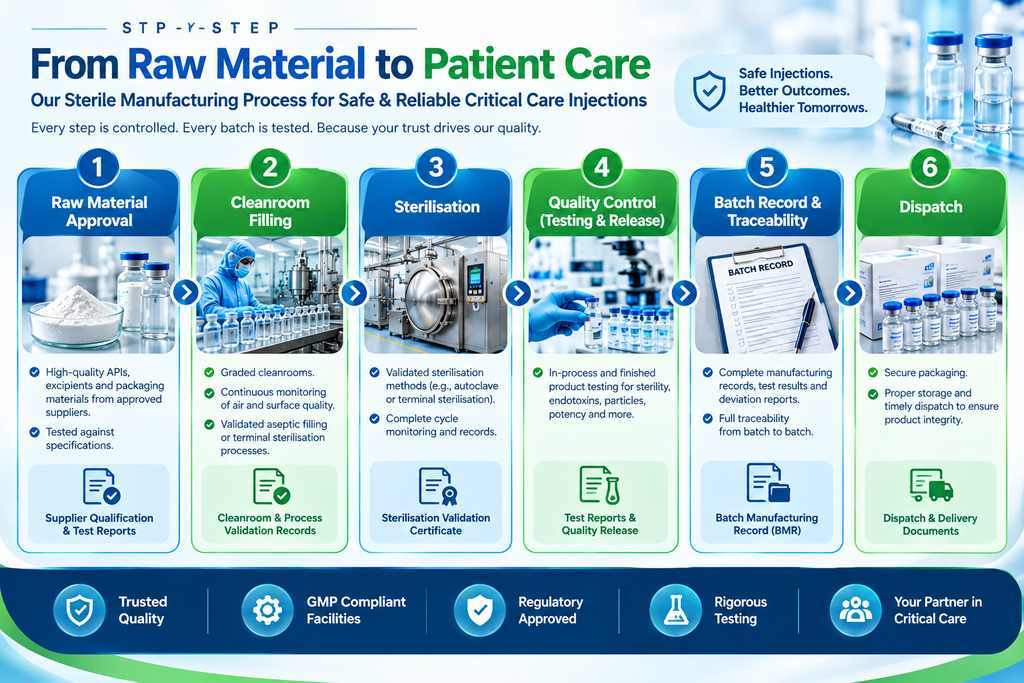
- Cleanrooms and monitoring. Graded cleanrooms, regular air and surface monitoring, and a validated aseptic filling or terminal sterilisation process.
- Validated equipment and processes. Filling lines, sterilisers and cleaning procedures should be qualified.
- Controlled raw materials. APIs, excipients and packaging should come from approved suppliers and be tested against specifications.
- Batch records and traceability. Manufacturing records, test results and deviation reports must be kept and retrievable.
- Real, current certificates. Ask for the licence. If the manufacturer claims WHO-GMP, check the scope and validity. A logo on a brochure isn’t evidence.
How do you verify a manufacturer’s licence and track record?
Takeaway: To verify an injectable manufacturer, confirm its licence with the state drug licensing authority and search CDSCO’s public alerts for the company and its products.
Most buyers skip this step, and it’s the one that matters most.
- Ask for the licence number and product permissions. Confirm both with the state drug licensing authority.
- Check CDSCO’s website. CDSCO publishes regular lists of drugs declared “Not of Standard Quality” (NSQ) or spurious. Search for the manufacturer and each product you plan to buy.
- Look at inspection history where it’s available. Ask the company directly about past regulatory observations and how it closed them out.
- Match the licence to the product. A manufacturer licensed for one dosage form isn’t automatically licensed for another.
A clean record isn’t a guarantee. Still, a manufacturer who talks openly about its past observations is easier to trust than one who dodges the question.
Which quality control tests should every batch pass?
Takeaway: Every batch of an injectable should be tested for sterility, endotoxins, particulates, identity and strength, pH, and container closure integrity, with stability data behind the shelf life.
| Test | What it confirms |
|---|---|
| Sterility | No viable microorganisms |
| Bacterial endotoxins | Endotoxin levels within limits |
| Particulate matter | Visible and sub-visible particles controlled |
| Assay and identification | Right drug, right strength |
| pH and physicochemical tests | Formulation within specification |
| Stability studies | Shelf life and storage conditions hold up |
| Container closure integrity | The seal keeps the contents sterile |
Ask for a certificate of analysis (CoA) with every batch. If a supplier can’t explain how it tests, that tells you what you need to know.
What does a typical critical care injectable range include?
Takeaway: Critical care injectable ranges usually cover antibiotics, GI injections, emergency-care drugs, analgesics, and electrolyte and fluid preparations, but each manufacturer’s actual range depends on its licences and facilities.
Some companies manufacture in-house. Others market products made at licensed third-party sites. Both models are legitimate. What matters is that you know which applies to each product on the price list.
These are prescription medicines, and they should only be used under medical supervision.
Packaging, storage and cold chain: what to ask
Takeaway: Injectable quality depends on packaging, storage and transport as much as on the factory, so ask about all three before ordering.
- Packaging format: vials, ampoules or prefilled syringes, and which one suits your hospital customers.
- Labelling and tamper evidence: batch number, expiry date and strength should be clear.
- Storage and transport: some injectables need temperature control throughout distribution.
- Shelf life at dispatch: many buyers write a minimum into the order terms, for example 75% of shelf life remaining.
Should you test samples and audit the plant before ordering?
Takeaway: For critical care products, order samples, test them at an independent NABL-accredited lab, and audit the facility before placing a first bulk order.
If the volume justifies it, and with critical care products it usually does, do three things:
- Send samples to an independent NABL-accredited lab.
- Audit the plant in person or through a qualified third-party auditor. Look at the cleanrooms, the QC lab and the record-keeping.
- Review a sample CoA and batch record before you commit.
This costs time and a little money. A recall costs far more.
How to choose a manufacturer: five checks in order
Takeaway: Evaluate a critical care injection manufacturer in this order: credentials, quality systems, capacity, full pricing, then contract terms.
- Credentials. Verify licences, approvals and GMP documents. For third-party products, identify the facility that actually makes and releases each batch.
- Quality systems. Ask about sterility assurance, deviation handling, stability data and recalls. Get the answers in writing.
- Capacity and supply. Confirm lead times, dispatch schedules and how the supplier handles shortages. A late delivery of a critical drug is a patient-safety problem.
- Full pricing. Get one quote covering price, MOQ, packaging, tax, freight and payment terms. The cheapest quote often hides weak documentation or shaky supply.
- Contract terms. Settle who holds approvals, who handles labelling, who deals with complaints and who owns the IP.
Third-party manufacturing and private label: who is responsible for what?
Takeaway: Under loan-licence or contract manufacturing, the licensed manufacturer is accountable for production and quality release, and the brand owner is accountable for marketing and complaint handling.
If you plan to sell injectables under your own brand, get the legal structure clear first. Know who holds the manufacturing licence, who holds marketing responsibility, and who is accountable if a batch fails. Responsibilities are shared in these arrangements, but they shouldn’t be blurred. Put them in writing and make sure the agreement complies with current pharmaceutical rules.
What happens when something goes wrong? Complaints, pharmacovigilance and recalls
Takeaway: Ask every injectable supplier three separate questions about complaints, pharmacovigilance and recalls, because each process works differently.
- Complaints: How do you log, investigate and respond to a quality complaint, and how fast?
- Pharmacovigilance: How are adverse events reported, collected and passed on?
- Recalls: Can you trace any batch to its customers quickly, and have you run a recall before?
Batch traceability makes all three possible. Without it, a small problem becomes a large one.
Where does Dharmo Care Labs fit?
Takeaway: Dharmo Care Labs is a critical care injection company that pharma buyers can evaluate for injectable supply and partnerships, and the decision should rest on what the company can document.
Dharmo Care Labs is a Himachal Pradesh injectable company with its contact address in Barotiwala, Solan. It says its manufacturing facility at Baddi is WHO certified, though it doesn’t publish the certificate or licence numbers on the site. The injectable range is almost entirely dry powder antibiotics: cephalosporins such as ceftriaxone, cefepime and ceftazidime, penicillins like amoxicillin and ampicillin, carbapenems (meropenem, imipenem), and piperacillin-tazobactam, in strengths from 100 mg up to 4 g. It also lists dry syrups and takes contract orders for other brands. Before you place an order, ask which products are made at its own plant and which come from outside vendors.
Put Dharmo Care Labs through the same checks as any other supplier. Ask it for:
- The injectables, strengths and dose formats you need
- Licences, GMP records, product approvals and sample batch test data
- MOQ, pricing, payment terms and order-to-dispatch timelines
- Its approach to shortages, complaints, pharmacovigilance and recalls
- Product information and support for approved marketing or distribution arrangements
A supplier that answers all of this clearly and puts it on paper is giving you a good sign.
What should your contract spell out?
Takeaway: A supplier contract for injectables should cover quality, regulatory and commercial terms explicitly, so no responsibility is left to assumption.
- Quality: specifications, batch release criteria, CoA supply, change control, audit rights
- Regulatory: who holds licences and approvals, who handles labelling and artwork
- Commercial: pricing, MOQ, payment terms, delivery schedules, penalties for delay, exit terms
Questions to ask before you sign
- Which manufacturing licences and product approvals do you hold, and can I verify them?
- Has the company or any of its products appeared in CDSCO or state NSQ alerts?
- Which formulations and strengths do you offer?
- Does your site meet current GMP and revised Schedule M requirements?
- Can I see batch documentation and a sample CoA?
- How do you control sterility and endotoxins?
- What are your storage, cold chain and minimum shelf-life commitments?
- Can I order samples and audit the facility?
- How do you handle complaints, adverse events and recalls?
- Do you offer third-party manufacturing or private label, and who is responsible for what?
Bottom line
Verify first, negotiate second. Check the licence with the regulator, search for quality alerts, test samples, audit the site, and compare full quotes instead of headline prices. If Dharmo Care Labs is on your shortlist, run it through the same process and decide on what it can show you.
Key Takeaways
- A critical care injection manufacturer in India should have a verifiable licence, product approvals and GMP documentation that matches the products you want.
- Schedule M compliance is a 2026 baseline, and its status should be confirmed against current CDSCO and state notifications.
- Every batch needs sterility, endotoxin, particulate, assay, pH and container closure testing, with a CoA you can inspect.
- Independent NABL-lab testing of samples and a facility audit should come before the first bulk order.
- Compare full quotes (price, MOQ, packaging, tax, freight, payment terms), because the lowest headline price often hides weak documentation.
- In third-party or private-label deals, put the split of manufacturing, marketing and complaint responsibility in writing.
FAQs
What should I check before choosing a critical care injection manufacturer in India?
Check the manufacturing licence, GMP compliance, product approvals, quality testing methods, regulatory track record, product range and supply reliability.
How do I verify a manufacturer’s licence?
Get the licence number and confirm it with the state drug licensing authority. Then search CDSCO’s public alerts for the company and its products.
Why does GMP matter so much for injectables?
Injectables go directly into the body, so contamination can cause serious harm. GMP makes sure each batch is made and tested to the same standard.
Which quality tests are essential?
Sterility, bacterial endotoxins, particulate matter, assay, pH, stability and container closure integrity.
Should I test samples before a bulk order?
Yes. Send samples to an independent accredited lab and review a sample CoA first.
Can I get critical care injections through third-party manufacturing?
Yes, authorised pharma companies can, provided the licences, product approvals and quality agreements are in place.
How do I evaluate Dharmo Care Labs?
Review its product portfolio, manufacturing arrangements, licences, quality documents, pricing and delivery commitments before signing anything.
Why does batch traceability matter?
It lets you trace a defective product to its batch, investigate quickly and run a recall if needed.
Who are the top 10 critical care injection manufacturers in India?
Sun Pharma, Cipla, Gland Pharma, Fresenius Kabi India, Axa Parenterals, Venus Remedies, Nectar Lifesciences, Emfica Pharmaceuticals, Novalab Critical Care and Criticine Care are the main names. This list is based on their stated injectable portfolios, not market-share ranking.
- Sun Pharma: big drugmaker with injectables in a wide range.
- Cipla: sterile injectables for hospital use.
- Gland Pharma: built mostly around injectables.
- Fresenius Kabi India: injectables and IV infusions.
- Axa Parenterals: sterile parenteral and hospital-care products.
- Venus Remedies: injectable antibiotics and anti-infectives.
- Nectar Lifesciences: formulations with an antibiotic background.
- Emfica Pharmaceuticals: critical care and injectable range.
- Novalab Critical Care: critical care injectables.
- Criticine Care: critical care injectables and pharma services.
Author Box
Dharmo Care Labs is a critical care injection company serving pharma buyers. Based in Himachal Pradesh, it supplies dry powder antibiotic injectables, mainly cephalosporins, penicillins and carbapenems, from a Baddi facility it describes as WHO certified.