- Dharmo Care Labs Pvt. Ltd.
Manufacturers and Suppliers of Quality pharma Injections and Dry Syrups all over India

Third Party Injection Manufacturing in India: Complete Guide to Choosing a Reliable Manufacturer
Written by the Dharmo Care Labs Pvt. Ltd · Last updated 29 September 2026
A practical guide for pharmaceutical companies, startups, PCD businesses, and healthcare brands seeking reliable third party injection manufacturing in India.
Featured Snippet Box
Third party injection manufacturing in India is an arrangement where a pharmaceutical brand, PCD company or startup hires a licensed manufacturer to produce injectable products such as liquid, dry powder and lyophilized injections under its own brand. Buyers should verify licences, quality systems, testing, documentation, MOQ and delivery terms before signing.
Third Party Injection Manufacturing in India: Complete Guide to Choosing a Reliable Manufacturer
Third party injection manufacturing lets a pharma company, PCD business or startup outsource the production of injectable products to a licensed manufacturer instead of building a sterile facility of its own. The buyer owns the brand and handles marketing and distribution. The manufacturer handles production, testing and packing.
Injectables are unforgiving. A sterile product that’s made badly can’t be fixed after the fact, so the manufacturer you choose matters far more here than it does for tablets or syrups. This guide covers how the process works, the dosage forms involved, what to check before you commit, the documents to ask for, what drives cost, and the mistakes buyers make most often.
Key Takeaway: Third party injection manufacturing allows pharmaceutical companies, PCD pharma businesses, startups and established brands to outsource injectable production to a qualified manufacturer. Before selecting one, evaluate manufacturing capabilities, applicable licences, quality systems, product documentation, testing, packaging requirements, minimum order quantities and delivery processes.
What Is Third Party Injection Manufacturing?
Takeaway: Third party injection manufacturing is a commercial arrangement in which one company manufactures pharmaceutical injections that another company sells under its own brand.
Two parties are involved. The manufacturer owns or operates the production facility, holds the manufacturing licence and makes the product. The marketer or brand owner markets and sells it, usually under its own name and packaging.
Who is responsible for what isn’t fixed. Responsibility for product quality, regulatory documentation, batch release and complaint handling depends on the manufacturing agreement, applicable regulations and the specific product arrangement. No single template applies to every deal, so read the agreement closely rather than assuming the manufacturer covers everything.
Pharmaceutical injections are sterile products given by routes such as intravenous, intramuscular or subcutaneous. Sterility requirements make injectables among the most tightly controlled products in any manufacturer’s range, which is why this guide spends so much time on vetting.
Explore Product
How Does Third Party Injection Manufacturing Work?
Takeaway: Third party injection manufacturing typically moves through nine stages, from defining the product to batch release and dispatch, and the exact order can vary by manufacturer.
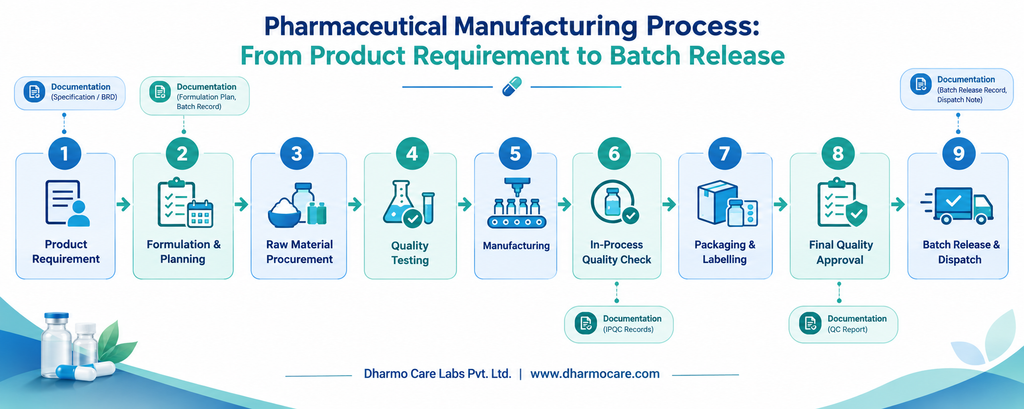
1. Product Requirement
The buyer defines what they want to sell: composition, strength, dosage form, pack size and target market. Vague requirements at this stage cause most of the delays later.
2. Product and Manufacturer Evaluation
The buyer checks whether the manufacturer can actually make the intended injectable and whether the facility suits the dosage form. This is where a site visit or virtual facility review earns its keep.
3. Documentation and Regulatory Requirements
Both sides confirm which licences, product permissions and supporting documents apply. Requirements differ by product and dosage form, so this step shouldn’t be rushed.
4. Quotation and Commercial Discussion
The manufacturer issues a quotation covering price, quantity, packaging, testing, taxes, transport and timeline. A quote that leaves these out isn’t really a quote (there’s a checklist further down).
5. Manufacturing Agreement
The parties define responsibilities, quality expectations, batch documentation, packaging approval, payment terms and dispute handling in writing.
6. Batch Manufacturing
Production begins after artwork, specifications and raw material arrangements are approved. Sterile manufacturing runs under controlled conditions.
7. Quality Testing
Each batch goes through the quality testing required for the product, and the results are recorded.
8. Packaging and Labelling
Finished products are packed and labelled according to the approved artwork and regulatory labelling requirements.
9. Batch Release and Dispatch
After quality review and documentation, the batch is released and dispatched to the buyer as per the agreed delivery terms.
Types of Pharmaceutical Injections Available for Third Party Manufacturing
Takeaway: Injectables for third party manufacturing generally fall into liquid, dry powder and lyophilized categories, and each needs different equipment, processes and quality controls.
Not every manufacturer makes every type. A facility set up for liquid vials may have no capacity for freeze-dried products. Confirm the specific dosage form and container format before you shortlist anyone.
Liquid Injections
Liquid injections are ready-to-use solutions or suspensions supplied in vials or ampoules. They’re the most common injectable format, but stability and sterility depend heavily on the formulation and the filling process.
Dry Powder Injections
Dry powder injections are supplied as sterile powder in a vial and reconstituted with a suitable diluent before use. Products that are unstable in solution are often made this way.
Lyophilized Injections
Lyophilized (freeze-dried) injections are produced by removing water from a frozen product under vacuum. The process needs specialised freeze-drying equipment and longer cycle times, so fewer manufacturers offer it.
Other Injectable Dosage Forms
Depending on the manufacturer, other formats may include pre-filled formats or specialised presentations. Only shortlist a manufacturer for these if it can show it makes them today, not that it plans to.
Why Choose Third Party Injection Manufacturing?
Takeaway: Companies use third party injection manufacturing mainly to avoid the capital, compliance burden and technical complexity of running their own sterile facility.
The legitimate reasons are practical:
- No facility of your own. Sterile plants are expensive to build, validate and maintain.
- Existing infrastructure. You use equipment and cleanroom setups already in place.
- Scalability. You can often adjust batch volumes as demand changes, subject to the manufacturer’s capacity.
- Lower capital requirement. Spending is usually lower upfront than building your own plant, though total costs depend on the arrangement.
- Manufacturing expertise. You draw on process knowledge you may not have in-house.
- Portfolio building. You can develop a branded injectable range without becoming a manufacturer.
- Focus. Your team concentrates on marketing and distribution.
Outsourcing doesn’t guarantee profit or lower costs. Margins depend on your pricing, market and volumes, and the manufacturer’s rates depend on the product. Anyone promising guaranteed savings is selling, not informing.
Who Can Benefit From Third Party Injection Manufacturing?
Takeaway: Pharmaceutical companies, PCD franchise businesses, startups, marketing firms and established brands all use third party injection manufacturing, for different reasons.
Pharmaceutical Companies
Companies without a sterile line can add injectables to their portfolio without new plant investment.
PCD Pharma Franchise Companies
PCD businesses often build a range of branded products manufactured elsewhere. Injectables can widen that range, provided the manufacturer’s documentation supports it.
Pharma Startups
A startup can launch without the capital a sterile facility demands. It does need a manufacturer that’s patient with first-time buyers’ questions.
Marketing Companies
Firms with a strong distribution network but no production capability can source finished injectables under their own brand.
Established Pharmaceutical Brands
Larger brands sometimes outsource specific injectables to free up their own capacity or to handle a peak in demand.
Businesses Expanding Their Injectable Portfolio
Companies already selling injectables may add new dosage forms or strengths through an additional manufacturing partner.
How to Choose the Best Third Party Injection Manufacturer in India?
Takeaway: The best manufacturer for you is the one that can prove, with documents, that it can make your specific injectable to the required quality standard on your timeline.
“Best” is a claim. A checklist is evidence. Use the following ten checks.
1. Manufacturing Facility and Capabilities
Confirm the facility handles your dosage form (liquid, dry powder or lyophilized) and container type. Ask to see the relevant section of the plant, in person or on video.
2. Applicable Manufacturing Licences
In India, drug manufacturing is regulated under the Drugs and Cosmetics Act, 1940 and the Drugs Rules, 1945, and licences are issued through the State Licensing Authority. Check that the licence is current and covers the product category you want. Licence types can differ depending on whether the manufacturer makes products under its own licence or on behalf of another company, so ask which applies to your arrangement.
3. Quality Management System
Ask how the manufacturer documents procedures, handles deviations, trains staff and controls change. A real quality system produces records on request.
4. Product Testing and Quality Control
Find out what testing is performed on each batch, whether it’s in-house or outsourced, and what records are kept. For injectables, sterility-related controls deserve particular attention.
5. Injectable Manufacturing Experience
Ask how long the facility has made injectables and which types. Experience with your dosage form matters more than general pharma experience.
6. Product Documentation
Ask what documents come with each batch and with product setup. See the next sections for a list.
7. Packaging and Labelling Support
Check which packaging formats are available, who designs and approves artwork, and how labelling compliance is handled.
8. Minimum Order Quantity
MOQ varies by product and pack. Get it in writing before you plan your launch volumes.
9. Production and Delivery Timeline
Ask for a realistic timeline from order confirmation to dispatch, and what typically causes delays.
10. Communication and Post-Order Support
Notice how quickly and clearly the manufacturer answers during the enquiry stage. That’s usually how the working relationship will continue.
Manufacturer Evaluation Checklist
| Factor | What to Check |
|---|---|
| Manufacturing capability | Relevant injectable dosage forms |
| Regulatory compliance | Applicable licences and permissions |
| Quality system | Documented quality procedures |
| Testing | Required quality testing and records |
| Documentation | Product and batch documentation |
| Packaging | Available packaging formats |
| MOQ | Minimum production requirement |
| Lead time | Expected manufacturing and dispatch timeline |
| Support | Communication and order coordination |
WHO-GMP and Quality Standards for Injection Manufacturing
Takeaway: GMP (Good Manufacturing Practice) is a set of quality standards for making medicines consistently, and buyers should verify a manufacturer’s compliance through current documents rather than accepting a certification claim at face value.
GMP covers how a facility is designed, how staff are trained, how materials are controlled, how batches are documented and how quality is checked. In India, GMP requirements are set out in Schedule M of the Drugs Rules, 1945, and the World Health Organization publishes its own GMP guidance that many manufacturers reference. Schedule M has been revised in recent years with phased compliance timelines, so ask the manufacturer how it meets the current requirements.
GMP matters more for injectables than for most dosage forms. A product injected into the body bypasses many natural defences, so contamination control, sterility assurance and documentation carry higher stakes.
A “WHO-GMP” label on a website is a claim. Actual compliance is shown by valid supporting documents issued by the relevant authority. Ask for the document, check its validity date and confirm it covers the facility and product category you’re buying. If a manufacturer can’t produce it, treat the claim as unverified.
Documents to Check Before Choosing an Injection Manufacturer
Takeaway: Before placing an order, ask the manufacturer for licences, GMP-related documents, product specifications, batch records and a written agreement, and verify each one directly.
- Manufacturing licence
- Applicable product permissions
- GMP-related documentation
- Product specifications
- Certificate of Analysis, where applicable
- Batch documentation
- Stability-related documentation, where applicable
- Quality agreement
- Manufacturing agreement
Note: The exact documents required can vary according to the product, dosage form, regulatory requirements and contractual arrangement.
Third Party Injection Manufacturing Cost in India
Takeaway: There’s no standard price for third party injection manufacturing, because cost depends on the product, batch size, packaging and testing requirements.
Any article quoting a fixed rate per vial is guessing. A cost estimate needs the specifics of your product. These are the factors that move the price:
- Product type and composition
- Strength
- Dosage form (a lyophilized product usually involves more process steps than a simple liquid)
- Batch size and order quantity
- Packaging type and printing/artwork
- Raw material requirements
- Testing requirements
- Regulatory and documentation requirements
- Special manufacturing requirements
Order size often matters more than buyers expect. A small first batch can cost more per unit than a larger repeat order, so ask how pricing changes with quantity.
What Should Be Included in a Manufacturing Quotation?
A useful quotation should state:
- Product name and composition
- Strength and pack size
- Quantity
- Packaging details
- Testing included
- Documentation provided
- Taxes
- Transportation
- Delivery timeline
If any of these are missing, ask before comparing quotes. Two quotations can look different in price only because one leaves out testing or transport.
Third Party vs Contract Injection Manufacturing
Takeaway: The industry doesn’t use “third party manufacturing” and “contract manufacturing” consistently, so the terms in your agreement matter more than the label.
| Point | Third Party Manufacturing | Contract Manufacturing |
|---|---|---|
| Basic concept | Outsourced manufacturing arrangement | Manufacturing performed under a contractual arrangement |
| Manufacturing facility | External manufacturer | Contract manufacturer |
| Commercial structure | Depends on agreement | Depends on agreement |
| Responsibilities | Defined contractually | Defined contractually |
| Best approach | Depends on business model | Depends on project requirements |
In some companies, “third party” means a buyer sells finished goods under its own brand. “Contract manufacturing” may mean a buyer supplies its own formula and specifications. Others use both terms interchangeably. Whatever a manufacturer calls its model, ask what’s included and who handles what.
Third Party Injection Manufacturer vs Own Manufacturing Facility
Takeaway: Outsourcing lowers the infrastructure burden, while owning a facility gives direct control at a much higher investment and compliance commitment.
| Factor | Third Party Manufacturing | Own Facility |
|---|---|---|
| Initial infrastructure | Lower requirement | Significant requirement |
| Manufacturing control | Depends on agreement | Direct control |
| Facility investment | External | Your responsibility |
| Operations | Outsourced | In-house |
| Scalability | Depends on manufacturer | Depends on own capacity |
Neither route is automatically better. A company with steady, high-volume injectable demand and the capital to run a compliant plant may reasonably build one. A company still testing the market usually shouldn’t.
Common Mistakes to Avoid When Selecting an Injection Manufacturer
Takeaway: Most manufacturer selection mistakes come from skipping verification, not from choosing the wrong company on paper.
- Choosing only on price. The cheapest quote often excludes testing, packaging or transport.
- Not checking manufacturing capabilities. A manufacturer that makes liquid injectables may not make lyophilized ones.
- Not verifying documentation. Licences and certificates should be seen, not assumed.
- Ignoring quality requirements. For sterile products, this is the mistake that costs the most.
- Not confirming MOQ. Discovering it after you’ve planned launch volumes is painful.
- Not clarifying packaging. Artwork approval and packaging formats need agreement early.
- Not defining delivery expectations. “Soon” isn’t a timeline.
- Not reviewing the manufacturing agreement. Responsibilities live there.
- Making unsupported certification assumptions. A logo isn’t a certificate.
- Not confirming product-specific requirements. General capability doesn’t equal capability for your product.
Questions to Ask a Third Party Injection Manufacturer
Takeaway: A short, specific list of questions quickly shows whether a manufacturer is ready for your product.
- What injectable dosage forms do you manufacture?
- What manufacturing licences apply to the facility?
- What quality systems are followed?
- What documentation is provided?
- What is the MOQ?
- What packaging options are available?
- What is the expected production timeline?
- What testing is performed?
- Can you manufacture according to specific product requirements?
- How are batch-related documents provided?
Pay attention to specificity. A capable manufacturer answers with details. A vague answer to a direct question is itself information.Why Choose Dharmo Care Labs Pvt. Ltd. for Third Party Injection Manufacturing?
Why Choose Dharmo Care Labs Pvt. Ltd. for Third Party Injection Manufacturing?
Takeaway: Dharmo Care Labs Pvt. Ltd. offers third party pharmaceutical manufacturing from Plot No. 12–24, Industrial Area, Barotiwala, Distt. Solan, Himachal Pradesh – 174103, with dry powder injections and cephalosporin formulations in its documented manufacturing scope.
Here’s what we make, what we can show you on paper, and how orders work. Check any of it against our documents before you commit.
| Detail | What we can tell you |
|---|---|
| Location | Plot No. 12–24, Industrial Area, Barotiwala, Distt. Solan, Himachal Pradesh – 174103, within the Baddi–Barotiwala pharma belt |
| Injectable dosage forms | Dry powder injections. Cephalosporin formulations are also part of our documented scope |
| Licence record | CDSCO records list Dharmo Care Labs Pvt. Ltd. for Dry Syrup, Dry Powder Injection and Cephalosporin, with validity shown up to 30 January 2028 |
| Quality control | Products go through quality testing and analysis by our quality assurance team |
| Product range | Injections, dry syrups, syrups, tablets, capsules and other pharmaceutical categories, as listed on our official website |
| Packaging | Packaging is arranged to client requirements. Formats vary by product, so we confirm them before you place an order |
| Scale | We manufacture a wide range of injections, with over 150 injection ranges |
| Dispatch | Finished products are delivered to your location anywhere in India |
Our Injectable Manufacturing Capabilities
Our injectable work centres on dry powder injections and cephalosporin formulations. That’s where our licence record and manufacturing scope point, and it’s where we’d steer a new client. If your product sits outside these categories, ask us first. A clear “not a fit” saves you weeks.
Our Quality and Documentation Process
Our quality assurance team tests and analyses products as part of routine manufacturing. For third party clients, the paperwork side of the job covers product selection, pricing, artwork and design, and the contract documents that define who is responsible for what. The exact documents you receive depend on your product and agreement, so tell us early what your own quality team needs to see.
Our Third Party Manufacturing Process
- Choose your product. Share the composition, strength and pack size you have in mind, or pick from our range.
- Confirm feasibility and pricing. We check the product against our facility and scope, then send a written quotation.
- Approve artwork and design. Your labels and cartons are finalised and signed off before printing.
- Sign the agreement. The contract sets out responsibilities, documentation and commercial terms.
- Manufacture and test. The batch is produced and put through quality testing.
- Pack and label. Packaging follows your approved requirements.
- Deliver. Finished goods are dispatched to your location across India.
Talk to Us
Address: Plot No. 12–24, Industrial Area, Barotiwala, Distt. Solan, Himachal Pradesh – 174103
Phone: +91 96468 31892 · +91 93161 39618
Our Injectable Manufacturing Capabilities
[List only actual capabilities, such as dosage forms, container formats and batch ranges.]
Our Quality and Documentation Process
[Describe the verified quality and documentation process, including which documents accompany each batch.]
Our Third Party Manufacturing Process
- Share your product requirement
- Review of feasibility and documentation
- Quotation and commercial terms
- Agreement and artwork approval
- Batch manufacturing and quality testing
- Packaging, labelling and batch release
- Dispatch
Key Takeaways
- Third party injection manufacturing lets brands sell injectables without owning a sterile facility.
- Responsibilities depend on the manufacturing agreement, so define them in writing.
- Verify licences and GMP documents directly instead of trusting website claims.
- Cost depends on product, batch size, packaging and testing, and no fixed price applies across products.
- Confirm MOQ, packaging and delivery timeline before committing.
- Ask specific questions and judge the manufacturer by how specifically it answers.
Frequently Asked Questions
What is third party injection manufacturing?
Third party injection manufacturing is an arrangement where a licensed manufacturer produces injectable pharmaceutical products for another company to sell under its own brand. The brand owner handles marketing and distribution, while the manufacturer handles production, testing and packing, as set out in their agreement.
How do I choose a third party injection manufacturer in India?
Start with verification. Check the manufacturing licence, GMP-related documents, dosage-form capability, testing procedures, MOQ, packaging options and delivery timeline. Ask specific questions and request documents rather than relying on claims. Where possible, visit the facility or request a virtual walkthrough before placing an order.
What types of injections can be manufactured through third party manufacturing?
Common categories include liquid injections, dry powder injections and lyophilized injections, in formats such as vials or ampoules. Availability depends on the manufacturer’s equipment and licence, so confirm that the facility makes your specific dosage form and container type.
What documents should I check before selecting an injection manufacturer?
Ask for the manufacturing licence, applicable product permissions, GMP-related documentation, product specifications, Certificate of Analysis where applicable, batch documentation and the manufacturing and quality agreements. Required documents vary by product, dosage form and contractual arrangement.
How much does third party injection manufacturing cost in India?
No fixed price applies. Cost depends on composition, strength, dosage form, batch size, packaging, raw materials, testing and documentation requirements. Ask for a detailed quotation that includes testing, taxes, transport and delivery timeline so quotes from different manufacturers can be compared fairly.
What is the difference between third party and contract injection manufacturing?
Industry usage varies. Some companies use “third party” for branded finished goods and “contract” for manufacturing to a buyer’s specifications, while others treat the terms as interchangeable. Confirm how a manufacturer defines each term and what responsibilities its agreement assigns to each party.
How long does third party injection manufacturing take?
Timelines depend on the product, documentation status, artwork approval, raw material availability, testing and batch size. Ask the manufacturer for an expected timeline from order confirmation to dispatch, and what commonly causes delays for products like yours.
What is the minimum order quantity for injection manufacturing?
MOQ varies by manufacturer, product, dosage form and pack size. There’s no industry-wide figure. Ask each manufacturer for the MOQ for your specific product in writing before planning launch volumes.
Looking for a Third Party Injection Manufacturer in India?
If you’re evaluating injectable manufacturing options, Dharmo Care Labs Pvt. Ltd can walk you through capabilities, documentation and timelines for your product.
- Company:– Dharmo Care Labs Pvt. Ltd
- Phone:– +91 9646831892
- Email:– dharmocare22@yahoo.com
- Manufacturing location:– Plot no 12-24 Industrial Area, Barotiwala Distt. Solan, Himachal Pradesh, 174103
- Service page:– https://www.dharmocare.com/third-party-manufacturing/
[Request a Manufacturing Consultation] or [Get a Third Party Injection Manufacturing ]
Author Box
Dharmo Care Labs Pvt. Ltd. is a pharmaceutical manufacturer based in Barotiwala, Himachal Pradesh, offering third-party manufacturing solutions for dry powder injections and cephalosporin formulations. The company provides injection manufacturing support and a range of pharmaceutical products for businesses across India.
References
- World Health Organization (WHO). WHO Good Manufacturing Practices for Sterile Pharmaceutical Products. WHO Technical Report Series No. 1044, Annex 2, 2022. who.int
- Central Drugs Standard Control Organization (CDSCO). Drugs and Cosmetics Act, 1940 and Drugs Rules, 1945, including Revised Schedule M (GMP). cdsco.gov.in
- Government of India. The Drugs and Cosmetics Act, 1940. India Code
- Goods and Services Tax Network (GSTN). GST Portal: Registration and Verification. gst.gov.in
Last reviewed: September 2026. Licensing and GMP rules change, so confirm a manufacturer’s current licence and compliance status with CDSCO or the State Licensing Authority before you place an order.